A lot of the times, we take things for granted. We don’t realise how breathing is integral to our life until it becomes difficult. Shortness of breath while climbing a flight of stairs or unexplained fatigue that’s been making your daily life difficult — these could be signs of an underlying lung issue.
Diagnosing what’s contributing to the symptoms is vital for managing them. This is where pulmonologists prescribe a pulmonary function test, or PFT. This test is an essential part of diagnosing and managing different respiratory diseases.
However, are you curious what is involved in the process? We will break down all the steps in the pulmonary function test in this detailed guide.
Why Do Doctors Order a Pulmonary Function Test?
If your pulmonologist has prescribed you a pulmonary function test (PFT), you must be wondering, “Why though?” So, even before we explore the details of what goes into a PFT, let us understand why it is recommended in the first place.
1. For diagnosing specific respiratory conditions
If you present with chronic respiratory symptoms, a PFT helps distinguish between obstructive lung disorders (like asthma or chronic obstructive pulmonary disease, commonly known as COPD) and restrictive lung disorders (such as pulmonary fibrosis or sarcoidosis).
2. For monitoring disease progression
For patients already diagnosed with chronic lung diseases, undergoing regular PFT sessions allows your clinical team to track whether your lung function is stable, declining, or improving over time.
3. For evaluating treatment effectiveness
If you have been prescribed inhalers, steroids, or other therapeutic interventions, a follow-up PFT provides clear data showing whether your medication regimen is successfully opening your airways or preserving lung tissue.
4. For pre-operative assessment
Major thoracic or abdominal surgeries place significant stress on the respiratory system. Surgeons frequently request a PFT to evaluate whether a patient's lungs are strong enough to withstand anesthesia and the post-operative recovery period.
5. For assessing occupational exposure
People who work in environments with high levels of dust, chemical fumes, asbestos, or other airborne irritants undergo PFTs to monitor for early signs of occupational lung damage.
Either way, if you are presenting with distressing symptoms affecting your respiratory functions, then your pulmonologist or chest specialist will prescribe a PFT for a better and holistic understanding of what’s happening inside your body.
What are the Different Types of PFTs?
Depending on your medical history and the kind of symptoms you are experiencing, your doctor will prescribe different components of the pulmonary function test.
Some of the primary components or tests that comprise PFT are the following:
1. Spirometry
Spirometry is the most common type of PFT and measures the total volume of air you can forcefully exhale after taking a deep breath, alongside the speed of that exhalation. The results of this test evaluate the patient’s Forced Expiratory Volume in 1 second (FEV1) and the Forced Vital Capacity (FVC), both of which are key parameters that determine the respiratory/lung health of the patient.
2. Body Plethysmography
The second test that you might experience during your PFT is body plethysmography. While spirometry measures the air you can actively blow out, it cannot measure the air left behind in your lungs after a full exhalation, known as the residual volume (RV). This particular test solves that problem.
During this test, you sit inside a clear, airtight glass cabin or booth that resembles a large telephone box. As you breathe against a shutter valve inside the mouthpiece, changes in pressure inside the sealed booth allow the equipment to calculate the total amount of air inside your chest cavity, including the air you cannot physically exhale. This particular test is vital for patients suffering from restrictive lung disease.
3. Diffusion Capacity Tests (DLCO)
This test evaluates how easily oxygen travels from the microscopic air sacs in your lungs (alveoli) into your surrounding blood vessels. During a diffusing capacity of the lung for carbon monoxide (DLCO) test, you breathe in a minute, completely harmless trace amount of a testing gas mixture, hold your breath for approximately 10 seconds, and then rapidly exhale.
By analyzing how much of the tracer gas was absorbed by your body during those 10 seconds, the system calculates the health of your lung's gas-exchange membranes.
Usually, for a more holistic outlook of your respiratory health, you’d be prescribed to undergo all these tests after your initial consultation with our pulmonologists at Jindal Chest Clinic.
How to Prepare for a Pulmonary Function Test?
Even before the actual test happens, there are certain pre-test guidelines that you’d need to follow. Our specialists at Jindal Chest Clinic will provide you with all the relevant instructions.
The following are a few prep factors you need to prioritise before the test:
Firstly, if you take short-acting bronchodilators (rescue inhalers) or long-acting maintenance inhalers, our doctors at Jindal Chest Clinic will provide specific timelines regarding when to pause them before your appointment.
Secondly, you need to make certain dietary and substance restrictions. This includes not smoking or vaping at least 8 hours prior to the test. You’d also need to avoid consuming alcohol 4–8 hours before the appointment. Also, eat a light meal before the test and limit caffeine intake on the morning of your test.
Lastly, on the day of the PFT, wear loose and comfortable clothing that doesn’t restrict your chest or abdominal expansion.
Once you prep for the actual test, you next need to be aware of the steps that happen during a pulmonary function test.
The Step-by-Step PFT Process: What to Expect?
The moment you arrive at Jindal Chest Clinic for your pulmonary function test, you will be guided through a highly structured and step-by-step process managed by our experienced specialists at the clinic.
Here’s what to expect during the entire procedure:
1. Initial setup and management
The process starts with the technician taking your exact height and weight and confirming your age and biological sex. These factors are crucial because lung function data is not interpreted in a vacuum, and specialised software is involved to calculate a predictive value.
2. Securing the nose clip and mouthpiece
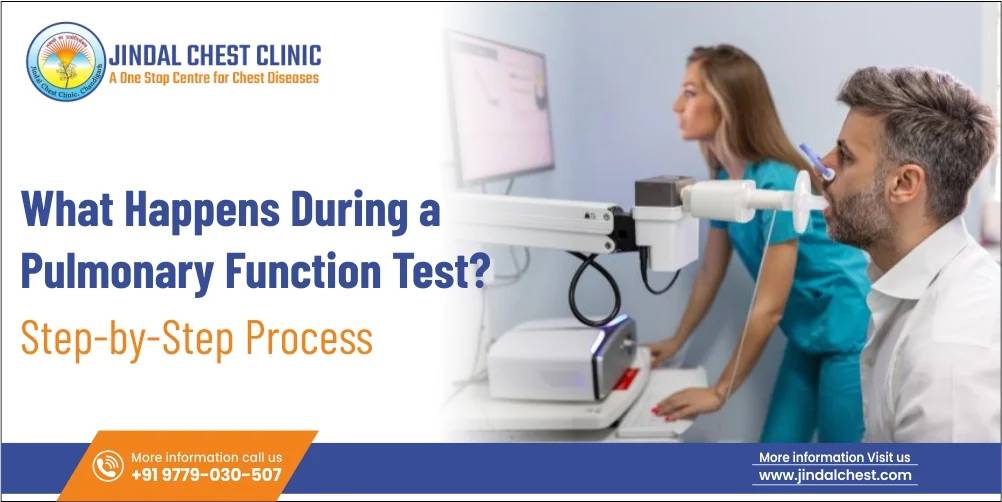
You will sit upright in a comfortable chair. The technician will place a soft, spring-loaded plastic clip over your nose. This forces you to breathe entirely through your mouth, preventing any air from leaking out through your nasal passages during forced exhalation trials.
You will then be asked to place a sterile, disposable rubber mouthpiece into your mouth. You must bite down gently on the inner tabs and seal your lips tightly around the outside of the tube to ensure zero air escapes from the corners of your mouth.
3. Conducting the spirometry phase
This is the most physically demanding portion of the appointment. The technician will coach you through a specific breathing sequence, involving:
- Normal breathing where you will take a few regular, steady breaths to establish a rhythm.
- Maximal inhalation, where you will be told to breathe in as deeply as physically possible, filling your lungs completely until you cannot hold any more air.
- Forced blast, where you will blast the air out into the tube as hard, fast, and violently as you can. The initial blast must be explosive.
- Sustained exhalation, where you must continue blowing out steadily without stopping or catching your breath for at least 6 full seconds.
- Final deep breath, where, once the 6 seconds conclude, you will take one final deep breath inward through the tube.
To ensure statistical reliability, you will repeat this entire cycle at least three times. Simultaneously, the technician will keep checking the computer screen to monitor whether or not your efforts are consistent throughout the process.
4. The bronchodilator reversibility assessment
Usually, after the spirometry test is done, your doctor at Jindal Chest Clinic will assess the reports. If your initial spirometry readings show signs of airway obstruction or narrowing, then this particular test is ordered.
In this, the technician will administer a fast-acting bronchodilator medication via an inhaler or nebulizer. You will then sit comfortably in the waiting room for 15 to 20 minutes, giving the medication time to relax the smooth muscles surrounding your airways.
After the initial wait, you will follow the same steps as you did during the spirometry test. By comparing your pre-medication scores with your post-medication scores, your pulmonologist can determine if your airway narrowing is reversible.
5. Advanced testing
If the initial findings from the above tests come out as abnormal and not satisfactory, that’s when the doctor will recommend a series of advanced testing to assess your total lung volumes or gas exchange capability. This is done via:
Plethysmography box: You will perform brief, rapid panting breaths against a closed shutter valve for a few seconds. This feels like panting like a puppy and takes less than a minute.
DLCO test: You will simply breathe in a quick breath of the testing gas mix, hold your breath while watching a countdown clock for 10 seconds, and then blow out smoothly and completely.
The cumulative finding of all these tests offers a clear picture of your lung and respiratory health. The entire pulmonary function test might be long and strenuous for some patients, but it is usually one of the best ways to diagnose complications and help our pulmonologists at Jindal Chest Clinic personalise the patient’s treatment plan according to their needs.
How to Read and Interpret PFT Results?
The final thing that you need to be aware of when it comes to PFT is knowing how to read and interpret the results.
Here’s a quick rundown of the same:
|
Diagnostic Pattern |
Key Metrics Change |
Underlying Meaning |
Common Causes |
|
Normal Lung Function |
FEV1/FVC ratio is within normal limits; total lung capacity matches predicted metrics. |
Your airways are clear, and your lung tissue is structurally healthy. |
Healthy lungs, resolved acute conditions. |
|
Obstructive Pattern |
Decreased FEV1 and a reduced FEV1/FVC ratio. |
Air can enter the lungs normally but encounters resistance during exhalation, taking too long to escape. |
Asthma, COPD, Emphysema, Chronic Bronchitis. |
|
Restrictive Pattern |
Proportional drop in both FEV1 and FVC; Total Lung Capacity (TLC) is reduced. |
The lungs are structurally stiffened or small, preventing them from expanding fully to hold a normal volume of air. |
Pulmonary Fibrosis, Sarcoidosis, Scoliosis, Neuromuscular diseases. |
At Jindal Chest Clinic, our priority is patient education and awareness. So, once the test is done and the results are available, our doctors will sit down with you and explain every little detail pertaining to the reports so you have a clear picture of what’s going on and what the next steps in the treatment plan would look like.
Partner with Jindal Chest Clinic for Your Respiratory Health!
Experiencing persistent breathing difficulties can be unsettling, but accurate diagnostic clarity is the first step toward reclaiming your quality of life.
At Jindal Chest Clinic, we provide advanced diagnostic testing and compassionate, comprehensive care for all forms of acute and chronic respiratory disorders.
Schedule a comprehensive pulmonary consultation at Jindal Chest Clinic today!
