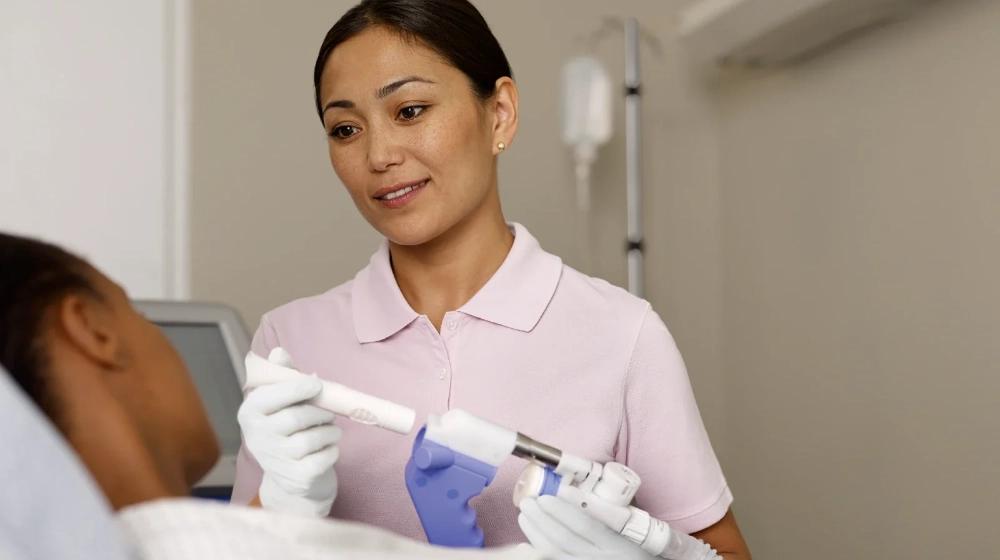
Breathing isn’t only about moving air in and out. For your body to get oxygen, it has to cross the thin walls of the tiny air sacs in your lungs and enter your blood. This function is called as Diffusion Capacity of the lungs (or Transfer Factor). If that step is impaired, you can feel breathless even when your airflow tests look normal.
A DLCO test checks exactly this step. It’s a quick, painless breathing test that measures how well gases move from your lungs into your bloodstream.
DLCO stands for Diffusing Capacity of the Lung for Carbon Monoxide. You breathe in a small, safe amount of a test gas, hold your breath for around 10 seconds and breathe out. The machine measures how much gas was absorbed. Doctors use it to investigate unexplained breathlessness and to evaluate or monitor conditions such as interstitial lung disease, emphysema and pulmonary vascular disease.
What Is a DLCO Test?
DLCO measures how efficiently carbon monoxide passes from the air sacs (alveoli) across the thin membrane into the blood in the surrounding capillaries. It is also called the transfer factor of the lung.
Carbon monoxide is used because it binds strongly to haemoglobin in red blood cells. The amount used is very small and controlled, and the test is performed with specialised equipment under trained supervision.
A DLCO test doesn’t directly measure the oxygen level in your blood. It estimates how well your lungs can transfer gases. See the Cleveland Clinic explanation for a patient-friendly overview. You can also read about the test at Jindal Chest on the DLCO page.
Why Is It Important?
Someone can have normal airflow and still have trouble with gas exchange. That’s why DLCO adds information that spirometry, which measures airflow, can’t provide alone.
A DLCO test can help doctors:
● Investigate unexplained breathlessness
● Evaluate suspected interstitial lung disease
● Assess emphysema and certain types of COPD
● Support the evaluation of pulmonary vascular conditions
● Monitor lung function over time
● Assess lung function before selected procedures or treatments
● Understand abnormalities found in other lung function tests
The result is always interpreted along with your symptoms, history, imaging and other lung function tests.
How Does It Work?
Your lungs contain millions of air sacs with thin walls surrounded by tiny blood vessels. Oxygen passes from the air sacs into the blood, and carbon dioxide passes the other way.
During the test, you inhale a measured gas mixture with a very small amount of carbon monoxide, hold your breath briefly and breathe out into the equipment. The machine measures how much carbon monoxide was absorbed and uses that to calculate your gas-transfer capacity.
When Is a DLCO Test Recommended?
● Unexplained breathlessness. If initial tests don’t fully explain breathlessness on walking, stairs or routine activity, DLCO can show whether impaired gas transfer is contributing.
● Suspected interstitial lung disease (ILD). ILD affects the tissue around the air sacs. Conditions such as pulmonary fibrosis can reduce gas transfer, and DLCO helps assess and track this.
● COPD and emphysema. In emphysema, the walls between the air sacs are damaged, reducing the surface area for gas transfer, so DLCO may be reduced. The result varies with the type and severity of disease.
● Suspected pulmonary vascular disease. Conditions affecting lung blood vessels, including pulmonary hypertension, can lower DLCO, but more tests are needed to find the cause.
● Monitoring lung disease. Repeat measurements can help show whether lung function is stable or changing.
● Before certain procedures or treatments. DLCO may be part of the assessment before selected surgeries or treatments that can affect the lungs, to establish a baseline.
If you’re unsure which conditions your doctor may be thinking about, see the lung and respiratory diseases overview at Jindal Chest.
How Is the Test Performed?
It’s done in a pulmonary function laboratory. It’s non-invasive, with no needles and no surgery, and uses the single-breath technique.
1. Preparation. The technician explains the test and asks about smoking, medicines and any recent illness.
2. Position. You sit comfortably and a nose clip is placed so you breathe only through the mouthpiece.
3. Breathe out. You breathe out fully, as instructed.
4. Breathe in the test gas. You inhale the measured gas mixture as deeply as you can.
5. Hold your breath. You hold for about 10 seconds, or as the protocol directs.
6. Breathe out. You exhale into the equipment, which analyses the gas to estimate how much was absorbed.
7. Repeat. The test may be repeated to get reliable, good-quality measurements.
The total appointment time depends on whether other lung function tests are done at the same visit.
How to Prepare
Follow your testing centre’s instructions, since protocols can differ. In general:
● Avoid smoking before the test for the period advised. MedlinePlus mentions at least 4 to 6 hours.
● Avoid a heavy meal and strenuous exercise just before.
● Wear comfortable clothing that doesn’t restrict breathing.
● Tell the technician about any recent chest infection, or any change in your health.
● Share your medicines and smoking history, and ask whether to use your inhalers before the test.
● Tell your doctor if you’ve recently had a blood transfusion, significant bleeding or a change in haemoglobin, since these can influence the result.
Don’t stop prescribed medicines unless your doctor tells you to.
What Do the Results Mean?
Your result is compared with a predicted value based on age, sex, height and other factors. The report may show the measured DLCO, its percentage of predicted, and a z-score or lower limit of normal. Reference ranges differ between laboratories, so don’t judge a number on its own.
● Normal DLCO: gas transfer is within the expected range. This doesn’t rule out every lung condition.
● Low DLCO: gas transfer is lower than expected. Possible causes include interstitial lung disease, pulmonary fibrosis, emphysema, pulmonary hypertension or other pulmonary vascular disease, anaemia, and certain lung infections or other conditions. Further evaluation is usually needed to find the reason.
● High DLCO: can occur with increased haemoglobin (Polycythemia), some forms of asthma, increased blood volume in the lungs or certain conditions involving lung bleeding. It also has to be interpreted in clinical context.
A result outside the expected range doesn’t by itself make a diagnosis.
What Can Affect the Result?
● Haemoglobin. Because carbon monoxide binds to haemoglobin, low levels (as in anaemia) can reduce the measured DLCO. Doctors may adjust for this when interpreting results.
● Smoking. Recent smoking can affect the measurement, so follow the lab’s instructions.
● Lung volume. Incomplete inhalation can give a lower reading.
● Age and body measurements. Accurate details are needed to compare with the right predicted values.
● Recent respiratory illness. An acute illness can temporarily affect lung function, and your doctor may consider the timing.
DLCO vs Spirometry
Both are lung function tests, but they answer different questions, so doctors often use them together.
|
|
DLCO |
Spirometry |
|
Main purpose |
Measures gas transfer from the lungs into blood |
Measures airflow: how much and how fast you can breathe out |
|
Common measurements |
DLCO and percent of predicted |
FEV1, FVC and FEV1/FVC ratio |
|
Helps evaluate |
Emphysema, interstitial and pulmonary vascular conditions |
Asthma, COPD and airflow obstruction |
|
Procedure |
Inhale a test gas, hold your breath, exhale |
Take a deep breath and blow out forcefully |
For a broader look at lung function testing, see Jindal Chest’s pulmonary function tests. If asthma is suspected, a FeNO test may also be used, since DLCO isn’t used alone to diagnose asthma.
Is It Safe?
Yes, when performed with standard procedures. It’s non-invasive and involves no radiation. The amount of carbon monoxide is very small and controlled. Some people feel temporarily light-headed or mildly uncomfortable from repeated breathing manoeuvres. Tell the technician if you feel unwell during the test. The team will also check that the test is suitable for you, especially if you have specific medical conditions or trouble performing the breathing manoeuvres.
What Happens After the Test?
A qualified professional reviews your result alongside:
● Spirometry and lung volume results
● Chest X-ray or CT scan findings
● Oxygen saturation
● Haemoglobin levels
● Your symptoms and medical history
For example, a person with breathlessness and a reduced DLCO might need more assessment for interstitial lung disease, emphysema or a pulmonary vascular condition. The next steps depend on the overall picture.
Get Your Lung Function Evaluated at Jindal Chest, Chandigarh
Spirometry shows how well air moves, and DLCO shows how well gas crosses into your blood. Together, with your history and imaging, they give doctors a fuller picture of your lung health.
If you have unexplained breathlessness or have been advised to have a detailed pulmonary function assessment, consult a chest specialist. At Jindal Chest, Chandigarh, you can get guidance on suitable lung function tests based on your history and clinical needs. You can book an appointment to discuss your symptoms.
Frequently Asked Questions
What does a DLCO test measure?
How efficiently carbon monoxide moves from the air sacs in your lungs into your blood. It estimates your lungs’ gas-transfer capacity.
Is DLCO the same as a pulmonary function test?
DLCO is one part of pulmonary function testing. A full assessment may also include spirometry and lung volume measurements.
How long does it take?
The breathing manoeuvre itself is short, but it may be repeated for accuracy. The whole appointment depends on whether other lung function tests are done too.
What does a low DLCO mean?
Gas transfer is below the expected range. It may be linked to emphysema, pulmonary fibrosis, pulmonary vascular disease or anaemia, and needs further evaluation to find the cause.
Can asthma affect DLCO?
DLCO is often normal, and sometimes higher than expected, in asthma. Results vary, and the test isn’t used alone to diagnose asthma.
Is it painful?
No. It’s a non-invasive breathing test using a mouthpiece and nose clip.
Do I need to stop my medicines before a DLCO test?
Not necessarily. Instructions depend on the lab’s protocol and the purpose of the test. Never stop prescribed medicines without medical advice.
Can DLCO diagnose lung cancer?
No. It measures gas transfer and may be part of a broader lung function assessment.
What is a normal DLCO value?
It depends on reference equations and factors such as age, sex and height. Doctors interpret it using the predicted range, z-score and overall clinical picture.
Who should have a DLCO test?
A doctor may advise it for unexplained breathlessness, suspected interstitial lung disease, emphysema or certain pulmonary vascular conditions, or when a detailed lung function assessment is needed.
